
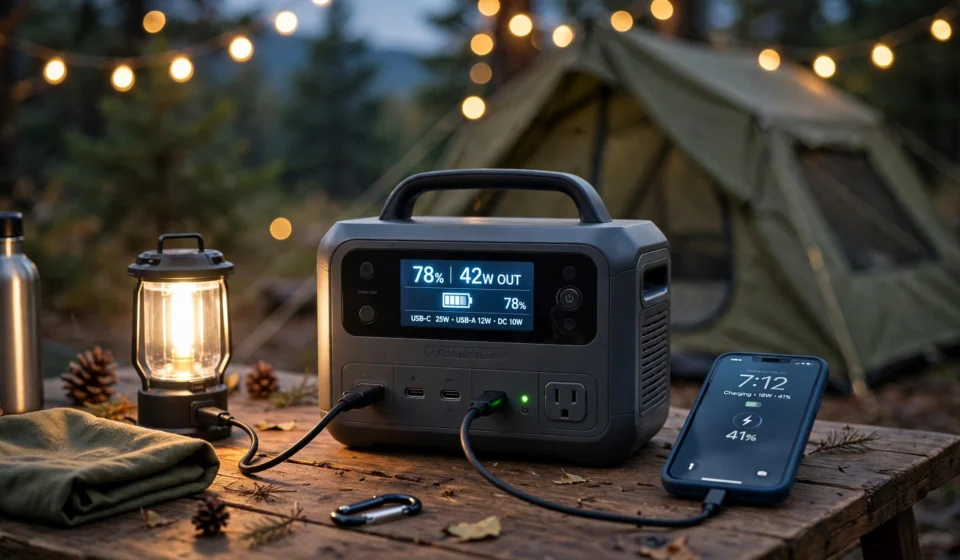

A portable power station takes the stress out of camping. Your phone stays charged, the lights stay on, and a small fridge keeps food cold all weekend. The catch: the market is full of oversized, overpriced boxes most campers do not need.
Here is the short version. For a weekend trip with two or three people, a station between 500Wh and 1,000Wh covers phones, lights, a camera, and a small cooler. Solo campers can go as small as 300Wh. Only step above 1,000Wh if you run a CPAP machine, a larger fridge, or power tools.
Below are seven stations picked from owner reviews and spec comparisons, priced from around $200 to $650, based on published specs, battery chemistry, charging speed, and owner feedback, not marketing claims.
How to Choose the Right Size
Capacity: watt-hours explained plainly
Capacity is measured in watt-hours (Wh). A 500Wh station delivers about 500 watts for one hour, or 50 watts for ten hours. Real output runs about 15 percent lower after conversion losses, so plan on 85 percent of the printed number.
LED camp lights sip power at 5 to 10 watts. A 12V camping fridge draws 40 to 60 watts in bursts, using roughly 300 to 500Wh a day. Add up one day of your gear, then double it for a weekend.
Output watts: what it can actually run
Output is different from capacity. A 600W rating means it can run anything pulling up to 600 watts at once, whatever the battery size. A kettle or hair dryer can pass 1,000 watts and trips a small station instantly. Fridges, laptops, lights, and CPAP machines sit comfortably under 200 watts.
Weight matters more than you think
Remember, you carry this box from trunk to tent. Under 10 pounds feels like a grocery bag. Around 25 pounds is a two handed carry. Past 35 pounds, most people just leave it by the car.
Battery type: LiFePO4 vs lithium-ion
Older, cheaper stations use lithium-ion cells rated for roughly 500 to 800 cycles before fading to 80 percent. LiFePO4 (lithium iron phosphate) cells last 3,000 cycles or more, handle heat better, and are safer. Every pick here uses LiFePO4, and a camping battery should still work five summers from now.
Solar charging
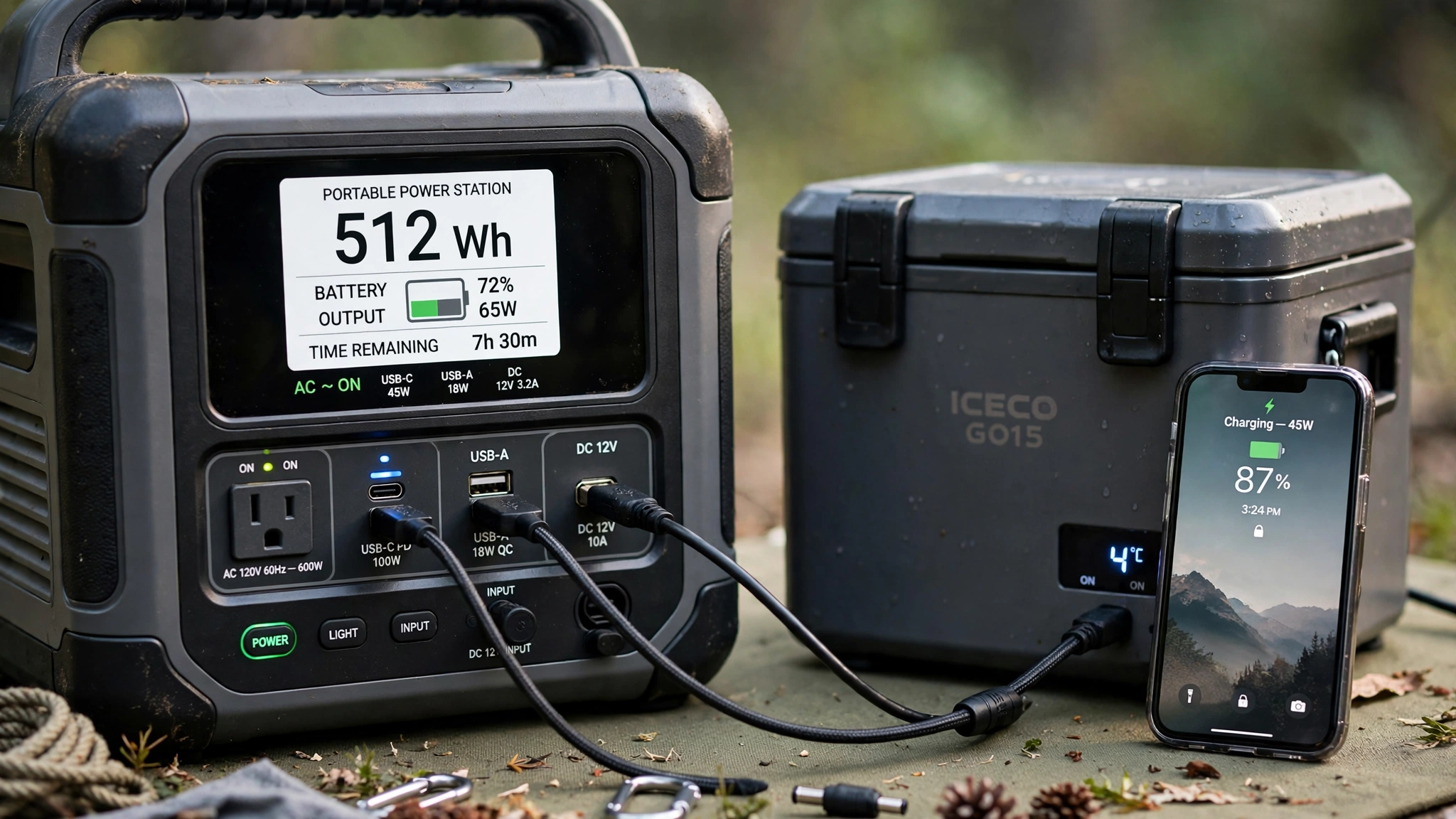
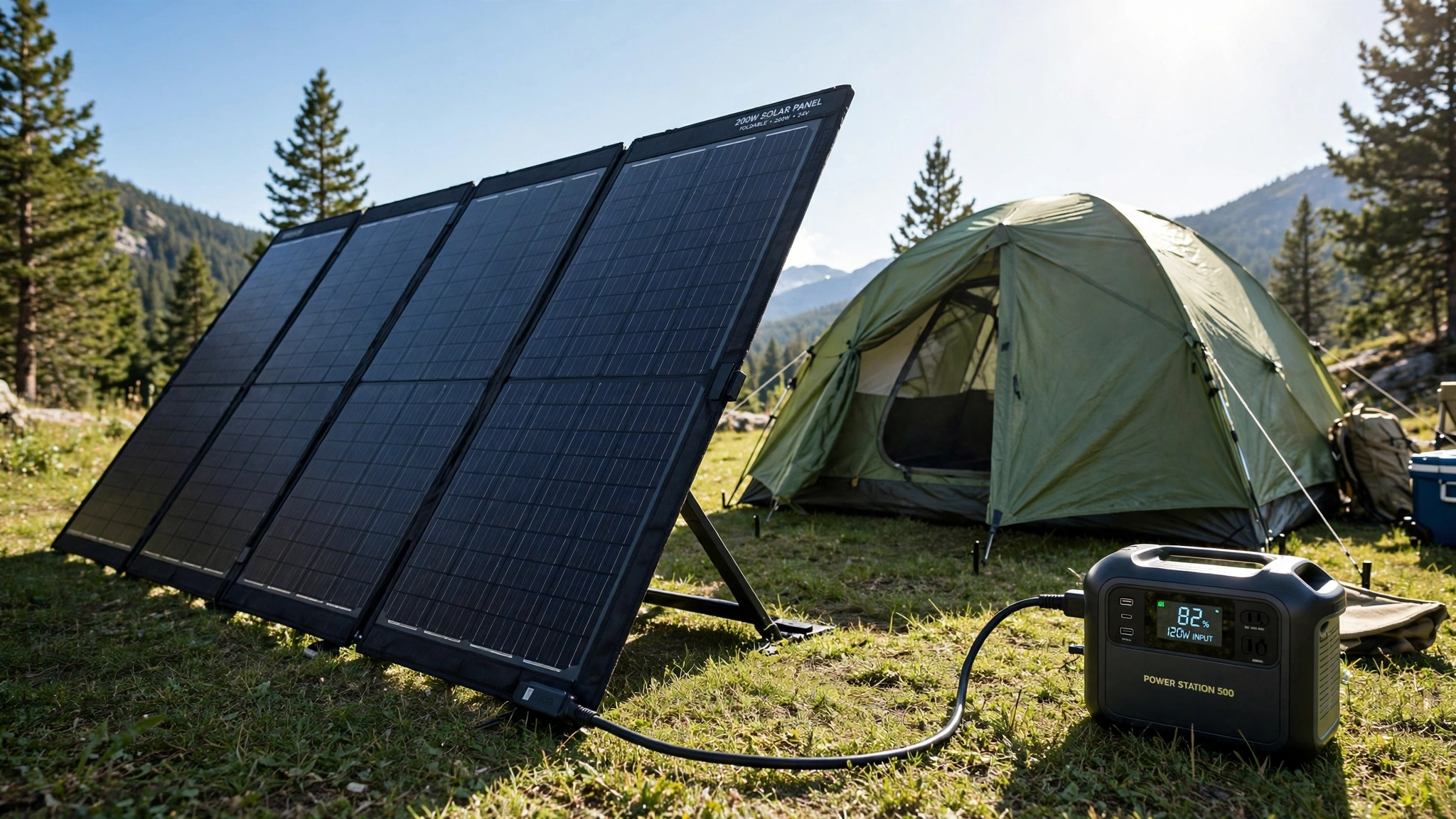
A 100W to 200W panel pairs well with most stations here. Expect about 70 percent of the printed wattage in real sun, less on cloudy days. REI has a solid plain-English guide to how portable power stations and solar charging work if you want to dig deeper.
The 7 Best Portable Power Stations for Camping
1. Jackery Explorer 1000 v2
The Explorer 1000 v2 is the station we would point most families to first. It packs 1,070Wh of LiFePO4 capacity and a strong 1,500W output into a box of about 24 pounds, so it runs a camping fridge, lights, phones, and a laptop through a long weekend. Wall charging takes it from empty to full in about an hour and a half, and it accepts up to 400W of solar input. The handle folds flat, handy in a packed trunk. Street price sits around $599, less during sales. The honest downside: it has no built in light, and the app is basic compared with EcoFlow’s.
2. EcoFlow Delta 2
The Delta 2 is the speed king of this list. Its 1,024Wh LiFePO4 battery charges from a wall outlet faster than almost anything else here, hitting 80 percent in about 50 minutes, which suits people who decide to camp on a Friday afternoon. Output is a generous 1,800W, enough for a small kettle or power tool in a pinch, and at around 27 pounds it is still a reasonable one person carry. EcoFlow’s app is the best in the business. Expect to pay around $499 on sale. The downside is noise. Under heavy load, the fans are audible inside a quiet tent, so light sleepers may want to charge it before bedtime.
3. Bluetti AC180
If raw capacity per dollar is your priority, the AC180 is hard to beat. You get 1,152Wh, the most on this list, plus an 1,800W output that shrugs off fridges, projectors, and camp kitchen gear. It charges quickly from the wall, takes up to 500W of solar input, and regularly sells for around $499. For a base camp where the station lives next to the car or in a van, it is excellent value. The trade off is weight. At roughly 35 pounds it is the heaviest pick here, and you feel every pound on a walk to a walk-in site. The app also feels a step behind EcoFlow and Anker. Buy it for capacity, not carrying.
4. Anker Solix C1000
Anker built its name on chargers, and the Solix C1000 shows that polish. It offers 1,056Wh of capacity and a class leading 2,000W output, so it handles almost any single appliance a camper would bring, including an electric cooler and a small coffee maker at once. SurgePad mode pushes brief peaks even higher for motors that spike at startup. Build quality feels a notch above the rest, the display is easy to read in bright sun, and the app gives clear live readings. Weight is around 28 pounds and the price sits near $549. Downside? The fans get loud during its very fast wall charging, and it costs more than the Delta 2 for similar capacity.
5. EcoFlow River 2 Pro
The River 2 Pro is the sweet spot for couples and lighter campers. Its 768Wh capacity covers a weekend of phones, lights, a drone, and a small fan, and at about 17 pounds it is easy to move around camp. Output is 800W, enough for everything except heating appliances, and wall charging takes roughly 70 minutes for a full charge. It is also one of the quieter stations here. Price is around $379, often less on sale. The downside is simply size. Run a 12V fridge around the clock and you will drain it in about a day, so fridge owners should look at the 1,000Wh class instead.
6. Bluetti EB3A
The EB3A is the small station that punches above its weight. Capacity is just 268Wh, but the 600W output is double what most rivals this size offer, so it can run a laptop, a CPAP for much of the night, or a small projector for movie night at camp. It weighs about 10 pounds, charges to 80 percent in around 40 minutes, and takes up less space than a shoebox. At roughly $209 it is an easy first step into camp power, and doubles as a home backup for your router. The limits are real, though. The battery cannot be expanded, and 268Wh disappears fast if you plug in anything hungry.
7. Jackery Explorer 300 Plus
For solo campers and minimalists, the Explorer 300 Plus is the one to beat. It holds 288Wh, weighs under 8 pounds, and slips into a tote bag or the corner of a trunk. The 300W output covers phones, lights, cameras, and a laptop, and it charges over USB-C as well as the wall, handy in newer cars. A small solar panel bundle is also available for festival weekends. Price is around $219. The downside is the 300W ceiling. Anything with a heating element is off the table, and a fridge will drain it in a few hours. Treat it as a personal power bank with wall outlets.
Quick Comparison
| Model | Capacity | Weight | Best for |
|---|---|---|---|
| Jackery Explorer 1000 v2 | 1,070Wh | ~24 lbs | Most families, all round use |
| EcoFlow Delta 2 | 1,024Wh | ~27 lbs | Fastest wall charging |
| Bluetti AC180 | 1,152Wh | ~35 lbs | Most capacity per dollar |
| Anker Solix C1000 | 1,056Wh | ~28 lbs | Highest output, build quality |
| EcoFlow River 2 Pro | 768Wh | ~17 lbs | Couples, lighter weekends |
| Bluetti EB3A | 268Wh | ~10 lbs | Budget pick, small loads |
| Jackery Explorer 300 Plus | 288Wh | ~8 lbs | Solo campers, minimal kits |
The same less is more logic applies to the rest of your kit. Our roundup of the best budget wireless earbuds with noise cancelling is worth a look for the drive out, and our honest take on whether AI smart glasses are worth buying covers another camper favorite.
Frequently Asked Questions
What size power station do I need for camping?
For most people, 500Wh to 1,000Wh is the sweet spot. That runs phones, lights, and a small fridge across a weekend. Solo campers can go down to 300Wh, while CPAP users or bigger groups should look at 1,000Wh or more.
Can a portable power station run a CPAP machine?
Yes. A typical CPAP draws 30 to 60 watts, so a 500Wh station usually lasts one to two nights. Turn off the heated humidifier if your settings allow it, since heating drains the battery much faster than airflow.
How long does it take to charge with solar?
With a 200W panel in good sun, expect roughly 120 to 150 real watts going in, so a 1,000Wh station needs seven to nine hours from empty. Small stations top up in two to three hours. Clouds stretch these numbers.
Can it run a mini fridge while camping?
Yes, if it is a 12V compressor model. Those draw 40 to 60 watts in bursts, using around 300 to 500Wh per day, so a 1,000Wh station handles one for a weekend. Avoid cheap thermoelectric coolers with small stations; they are far less efficient.
Is LiFePO4 worth paying extra for?
For camping, yes. LiFePO4 batteries last around 3,000 charge cycles or more, compared with 500 to 800 for older lithium-ion cells, and they tolerate heat better. For gear you keep for years, that longer life makes the small price gap an easy call.
The Bottom Line
If you only buy one station from this list, make it the Jackery Explorer 1000 v2 or the EcoFlow Delta 2. Both sit in the size class most campers actually need, charge fast, and use batteries built to last. Tight budgets are well served by the Bluetti EB3A, and solo travelers should look hard at the Explorer 300 Plus. Pick the size that matches your real gear list, not the biggest number you can afford.